Thursday, November 24, 2011

The E.U.R. - 1 - The Cubic Coliseum

Rome's "original" Coliseum needs no description nor introduction whatsoever, being one of the most famous things in the world, probably second only to Coca-Cola :)


What not everybody knows is that Rome also has a "cubic" Coliseum as well. It's one of the main buildings of the borough of E.U.R., one of the most special modern areas of Rome. Designed in the 30's  to host the World Exhibit of 1942 (the name E.U.R. itself is an acronym for "Esposizione  Universale Roma" ("Rome's Universal Exhibit") the E.U.R. was built according to the most modern architectural standards for the time, and what makes it different from other areas of Rome is that it's an area built from scratch, without being something based on pre-existing structures and without being just low-class housing. 


This building, initially called "Palazzo della Civiltà Italiana" (Palace of the Italian Civilization) and in post-war times renamed "Palazzo della Civiltà del Lavoro" (Palace of the Labour Civilization) was designed by a team of architects in 1936 whose project was selected among others proposed, was intendedly a "modern version" of Rome's most iconic monument, and it imitated its structure, with the arches, and statues under them, just like the ancient Coliseum used to be. You may now wonder... Where are the statues? This is another sad Italian story: when the construction was interrupted for the war, and the the Fascist Regime eventually fell, everything was left the way it used to be, and all the statues, complete and ready to be shipped to the site, never made it to Rome, and are still awaiting their fate in dusty warehouses. 


The main reason for the construction of the E.U.R. is propaganda: the Fascist Regime wanted to show the world the power and the modernity of the "new" (post World War I) Italy, and thus poured huge resources into this project, which was interrupted by the outbreak of World War II. And maybe this fact, which could be considered as a negative thing, adds to the place's atomsphere, because it gives the whole place an "interrupted dream" nuance, so that who visits can try imagning what the place would look once completed. 

Saturday, November 19, 2011

Michelangelo's Moses - Rome's Non-Talking Statue

Those who already read the previous post about Pasquino (you can find it clicking on this link: http://viewsofrome.blogspot.com/2011/08/romes-talking-statues-1-pasquino.html), know that Rome has some "talking statues". The Eternal City, however, also has a very stubborn statue, who refused to speak at his maker's request: Michelangelo's Moses. 

There are many stories related to this masterpiece located in a rather dim corner of the Basilica of San Pietro in Vincoli, on the Colle Oppio, the hill right opposite the Coliseum. The Basilica has this name (translating as "St. Peter in Chains") because it was built to contain a rather special relic: the chains that held St. Peter during his stay at the Mamertine Prison, located in the Forum area. 


The most interesting feature of this Basilica, however, is not the holy relic under the main altar, but a statue placed in a corner...  A masterpiece coming from two different failures, still one of the most stunning artworks available in Rome: Michelangelo's Moses.


The first failure came from the material itself: the marble block used to make this sculpture was discarded by another artists, who made a mistake in the inital phase of the making of his work, and who deemed the block no longer usable. Michalngelo picked up this block and made a real masterpiece out of it, being however forced to give the Moses a slightly unusual stance, turned towards the left, and a masterfully hidden disproportion beween the size of the two knees. 


Another failure that marked the destiny of this wonderful artwork, is that this statue was just a part of a magnificent tomb for the Pope Julius II (depicted in the upper part of the tomb), which was not completed before the Pope's death, as the great artist was deeply absorbed in other great artworks, such as the Sistine Chapel. Being too beautiful to be put is some dusty warehouse, the statue was put in the corner of this ancient Basilica. 


The reason why I called the Moses a "Non-talking statue" as opposed to the "Talking" ones like Pasquino, stems out of a legend: it is said that the great artist, upon completion of his artwork, being himself surprised by the quality and perfection of the statue, hit the Moses' knee with his hammer shouting: "Why don't you talk?!". Some claim that the mark of this hammer hit is still visible... possibly with the eyes of an art lover...


Related topic link: http://viewsofrome.blogspot.com/2011/08/moses-statue-at-largo-santa-susanna.html

Monday, November 14, 2011

Porta San Sebastiano - 1 - The Unnoticed Angel

Porta San Sebastiano is the ancient gate which allowed those travelling on the Appian Way to enter the Eternal City. The gate is still in use, being on a rather busy road intersection. While the surrounding section of Roman walls  is still original, the gate, through the centuries, has undergone several changes, both during the Middle Age, during the Renaissance period, and even in 20th Century, when Ettore Muti, one of the most famous components of the top brass of the Fascist regime, turned the gate into his very own pied-à-terre. 


This gate, which is itself a nice view, and besides being the entrance to visit a section of the walls, featurees a little "hidden treasure": on the left of the gate (for those "entering" the gate) engraved in the stone, there stands an angel with a spear in the mouth of a dragon trapped under his feet, representing evil. on the right side of the standing figure, there is a Latin text written in Oncial characters. Both the style of the depicted Angel and the "font" used for the text tells us that the image dates back to the Middle Age, most probably engraved by pilgrims who came to Rome and who had to wait for the gates to be open. 


Unfortunately this little treasure often goes unnoticed, as cars pass through the gate without having a chance to appreciate it.  Pedestrians willing to enjoy it will have to synchronize with the car traffic, since the engraving is inside the gate, and the passage is barely enough for a car to pass. 
The more curious (and daring) visitor can take a look at more engravings just on the opposite side, which are smaller and have the names and dates of pilgrimage. Rome is not the "City of Angels" but if you happen to pass by Porta San Sebastiano, you will fine one welcoming you in the Eternal City.


Saturday, November 5, 2011

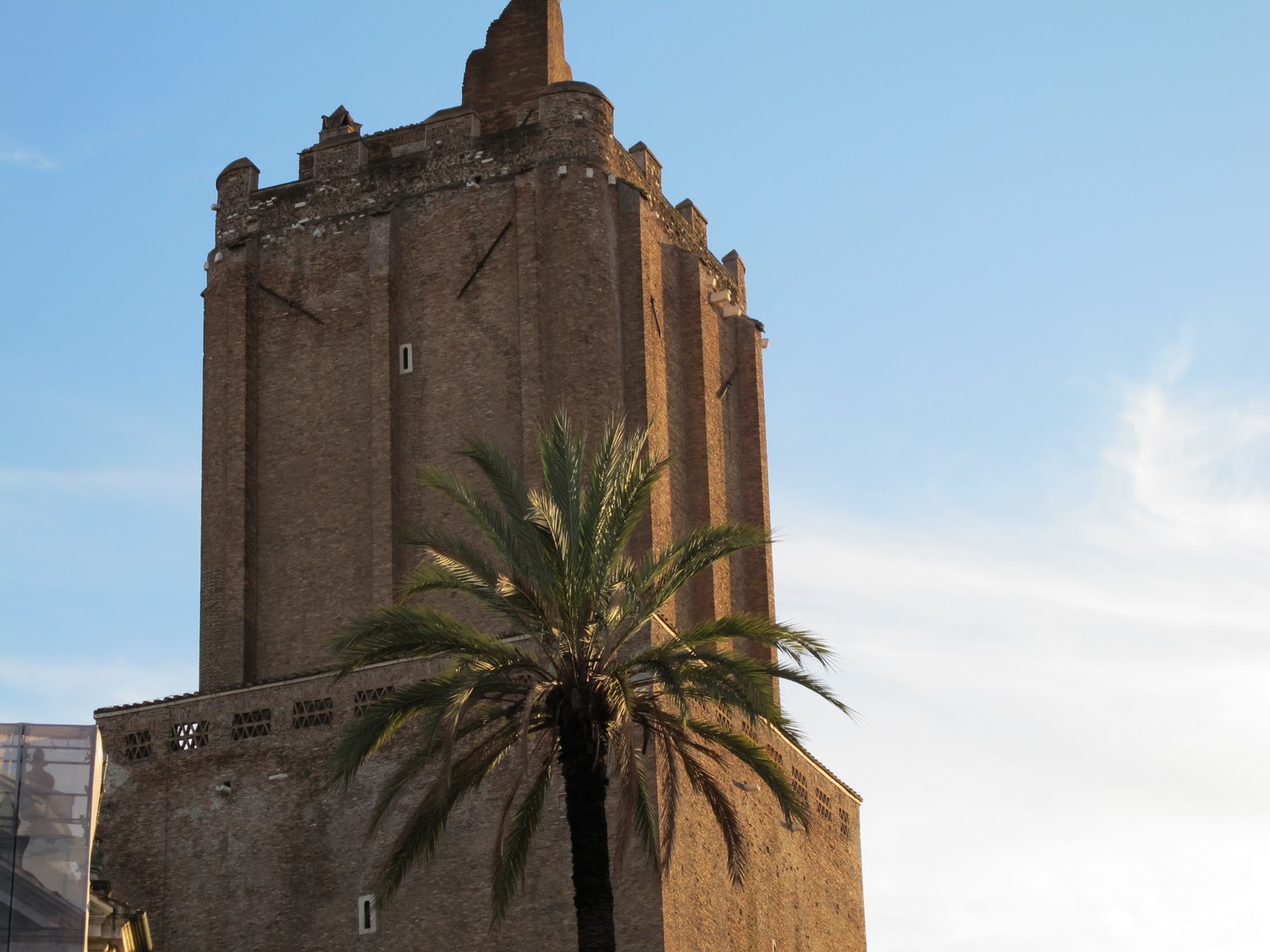
Myths about Rome - La Torre delle Milizie - Nero's "Observation Point"

On the hill right behind the Forum of Nerva, a tall tower made of red bricks stands out against the background of the sky. What looks like a quite anonymous building, is the stage for one of the biggest myths about Rome. 


The Tower, built back in 13th Century for the noble Conti family, and one of the few remaning buildings of the Middle Age in Rome, used to be a taller, three-tiered building, but the upper part was knocked down in 14th century owing to the effects of a strong earthquake that hit the City.  The name of "Torre delle Milizie" comes from an alleged presence of a military garrison's barracks, but until now, I could not find any historical evidence about this fact. 


Roman people built a myth about this tower, telling that that was the point from which the Emperor Nero watched Rome birning during the infamous fire that destroyed the city back in 64 A.D. Nothing could be farther from reality, because of 2 main facts:


- Emperor Nero was not in Rome at the outbreak of the fire, but at his seaside villa in Antium (today Anzio), and:
- the Tower was built in Middle Age, so it was not there at the moment of fire, 


but this is just one of the many stories without historical foundations who were made up in centuries of hatred against this unconventional and innovative Roman Emperor. 
Currently integrated in the archaeological complex of Trajan's Markets, the tower can be accessed entering from the same site's entrance, on Via Quattro Novembre.

Sunday, October 30, 2011

Il Vittoriano - A Typewriter, a Wedding Cake or Our National Pride?

On Piazza Venezia, you will find one of the most famous - and controversial - monuments of the whole Eternal City: The "Vittoriano", or "Altare della Patria" - "Altar of the Fatherland" - A monument built between 1911 and completed only in 1925  to celebrate the 50th Anniversary of the Unity of the Country (1861-1911), and to commemorate Vittorio Emanuele II, the first King of united Italy (statue in the middle of the monument.) 

The first controversial fact about the monument arose long before its completion, both during the long process of selection of the proposed projects among the ones submitted (315 from 13 countries) and from the supply of stone and marble chosen for the building, coming from the northern province of Brescia (with alleged interferences coming from the most powerful politicians of that time, including the Prime Minister). 


The discussions subsided after the end of World War I, with the enthusiasm following the Victory of 1918. In 1921 at the same monument was buried the Unknown Soldier, a soldier chosen on a battlefield in north-eastern Italy among those who had no identification plate with them,  transported to Rome with great honours, and buried there with great solemnity to symbolize the sacrifice of all the soldiers during all wars, but especially in WW I which for Italy was considered as the last one of the Wars for Independence, having manage to reconquer from the Austian Empire the territories of Trento and Trieste in northern Italy. 


During the following Fascist period, with the ideal of Fatherland becoming of paramount importance for the regime's propaganda, the Vittoriano became the stage for so many ceremonies of all kinds, with the military ones being the most frequently represented on the site. 


After the war, the monument lost part of its importance, and started becoming the target for heavy criticsm by the people: the allegedly not graceful shape of the monument, its being all white, and the face that it doesn't blend too well with the more ancient surroundings, earned the monuments nicknames such as "The Typewriter" (due to its shape) or  "The Wedding Cake" due to the color.


In more recent times, after having suffered a bomb attack back in the late 60s, the monument has been closed to the public only to be reopened in 1997. In 2011 it went back to his splendour and importance thanks a thorough refurbishment and for becoming one of the focal points of the celebrations for the 150th Anniversary of the Unity of Italy.


So, it's up to each one of us to decide if the Vittoriano is just a Typewriter, a Wedding Cake, or the materialization of our National Pride.

Thursday, October 13, 2011

"Domine, Quo Vadis?" - A small Church for a Miracle Encounter

On the Appian Way, less than half a kilometer away from Porta San Sebastiano (the main gate in Rome walls on Appian Way) and just metres away from the Catacombs of St. Callisto, there is a small church with a very simple façade, that can easily go unnoticed both by visitors and by Romans, often more concentrated on the nearby road intersection than on what surrounds them.


The little church, as stated also by the sentence written in Latin above the entrance door, was, according to tradition, the stage for a very special encounter: it is believed that St. Peter, fleeing Rome to escape the prosecutions by Emperor Nero, met Christ in this place, and asked him in Latin: "Domine, Quo Vadis?" meaning "Lord, where are you going?" and Christ, who was heading towards Rome, replied: "Eo Romam Iterum Crucifigi", which means "I'm going to Rome to be crucifixed again." From this sentence, Peter understood he should not run away, so he went back to Rome to meet his destiny or martyrdom.


Inside the church, on the floor, we can see a slab of white marble, on which there are engraved 2 footprints, believed to be the footprints of Christ himself (this can be seen from the sentences engraved on the edges of the slab). Historical and archaeological researches showed that the slab is indeed ancient, but in reality it was an "ex voto" made by travellers, probablyleft in the temple as a thanking to the Gods for the successful trip, or maybe as an offer before the trip to invoke their protection.


The little church can be a nice stop for the visitor on the Appian way en route to bigger attractions such as: the Catacombs, the Appian Way, or the ancient city walls, that can be visited in the section around the nearby gate of Porta San Sebastiano.


Thursday, September 8, 2011

Bernini vs. Borromini - 1 - The Four Rivers' Fountain

The two Geniuses of the Baroque in Rome, Bernini and Borromini, were divided by an unfriendly rivalry, which had outbursts which remained famous among Roman people. 

The two artist often competed to obtain the assignment of the construction of buildings, fountains and statues, but, more than anything else, they competed to be considered the best artist operating in Rome. 

Bernini was considered by far a better artist, given the marvelous artworks he adorned Rome with during all his life, while Borromini prided himself with his superior technical knowledge. being more of an Architect, and less of a Sculptor. This difference became especially evident when Bernini was appointed the construction of the 3 fountains in Piazza Navona, with the one in the middle of the square being the famous "Four Rivers' Fountain" (depicting the Tiber, The Nile, the Hindus and the Rio de la Plata), right in front of the church of S. Agnese in Agone, built by Borromini. 


Bernini started his work, but got stuck at a given point, because he did not manage to get water flowing from the fountain, and could not figure out why. His rival Borromini, being a great techinician, knew the solution to the problem, but he declared that he would rather be torture than telling his arch rival how to fix it.  Bernini was desperate, but he came up with one of his great ideas: he paid some people to invite him to dinner, and made him drunk. Under the effect of alcohol, the intoxicated artist revealed that the problem was in one of the pipelines bringing water to the fountain. Armed with this insight, Bernini performed the necessary adjustment, and, to his rival's astonishment, made the water spring out of his brand new artwork.


Not satisfied with this victory, Bernini enjoyed also some revenge over his rival: looking at the statue facing Borromini's church's façade, you can notice the man is in an odd position, gesturing as if he is prefenting the church from falling down, or scared by the building's ugliness. 

Villa Medici - A Foreign Queen's Whim

Christina, Queen of Sweden, was for sure one of the most interesting people of the 17th Century. Single by choice, she secretly converted ...