Showing posts with label Roman History. Show all posts

Wednesday, January 4, 2012

Ancient Superstitions - The Number 17

Unlike most countries around the world, in Italy the unlucky number is 17, not 13. This superstition has a story that traces back to ancient Rome, and refers to 2 specifical facts:


- The number 17 in Roman numbers is written as XVII (X=10 + V=5 + I=1 + I=1, Total = 17). Mixing up the letters, the only Latin word that can be formed is: VIXI, perfect tense of the verb VIVO (to live), which means "I used to live" and thus "I'm dead". 


- 17th Legion of the Roman Army was totally destroyed during the disastrous defeat suffered by the Romans in 9 AD in the German woods near the town of Teutoburg. The legion, at the command of the Consul Quintilius Varus was ambushed by the local troops, and, overpowered by the enemy, caught by surprise and stuck in the muddy soil, was exterminated to the last man. The defeat had such a great effect on Roman people that Legion no. 17 was never reformed, and number 17 became an infamous number, and it stayed as a symbol of bad omen.


The bad luck reputation of number 17 survived until today, to the point that in many contexts  in Italy  no.17 is skipped (or replaced by 16/B), and even on Alitalia flights, there is no row 17. 


Saturday, December 24, 2011

Sol Invictus - The Festivity Before Christmas

December 25th has always been a special day, since the ancient times. Several traditions overlap  on this day: the oldest one started in the year 272 AD, when Emperor Aurelianus imported from Syria, whose legendary Queen Zenobia was defeated during the same year,  the worship of the Sun, which was widely practiced in that area of the world. The Emperor ordered the construction of a new temple on the Quirinal Hill, which was inaugurated on December 25th, 274 AD, giving officiality to this new kind of worship.
From that year on, Dec. 25th was a sacred day, namely "Dies Natalis Solis Invictus" (Day of Birth of the Invincible Sun). 


This celebration also overlaps with another "Sol Invictus" celebration, that was related to the fact that, despite the Solsitce of Winter in on December 21st, only on the 25th the first visible signs of improvement of the daylight length, and of the height of the sun over the horizon start appearing. 


Only at the end of the 4th century AD, when the celebration of Christmas started officially (the Edict of Theodosius of 380 AD banned all worships other than Christianity), the day of December 25th, after several centuries was turned from a late Pagan festivity into one of the most sacred days for Christianity.


Merry Christmas everybody!
  

Saturday, November 5, 2011

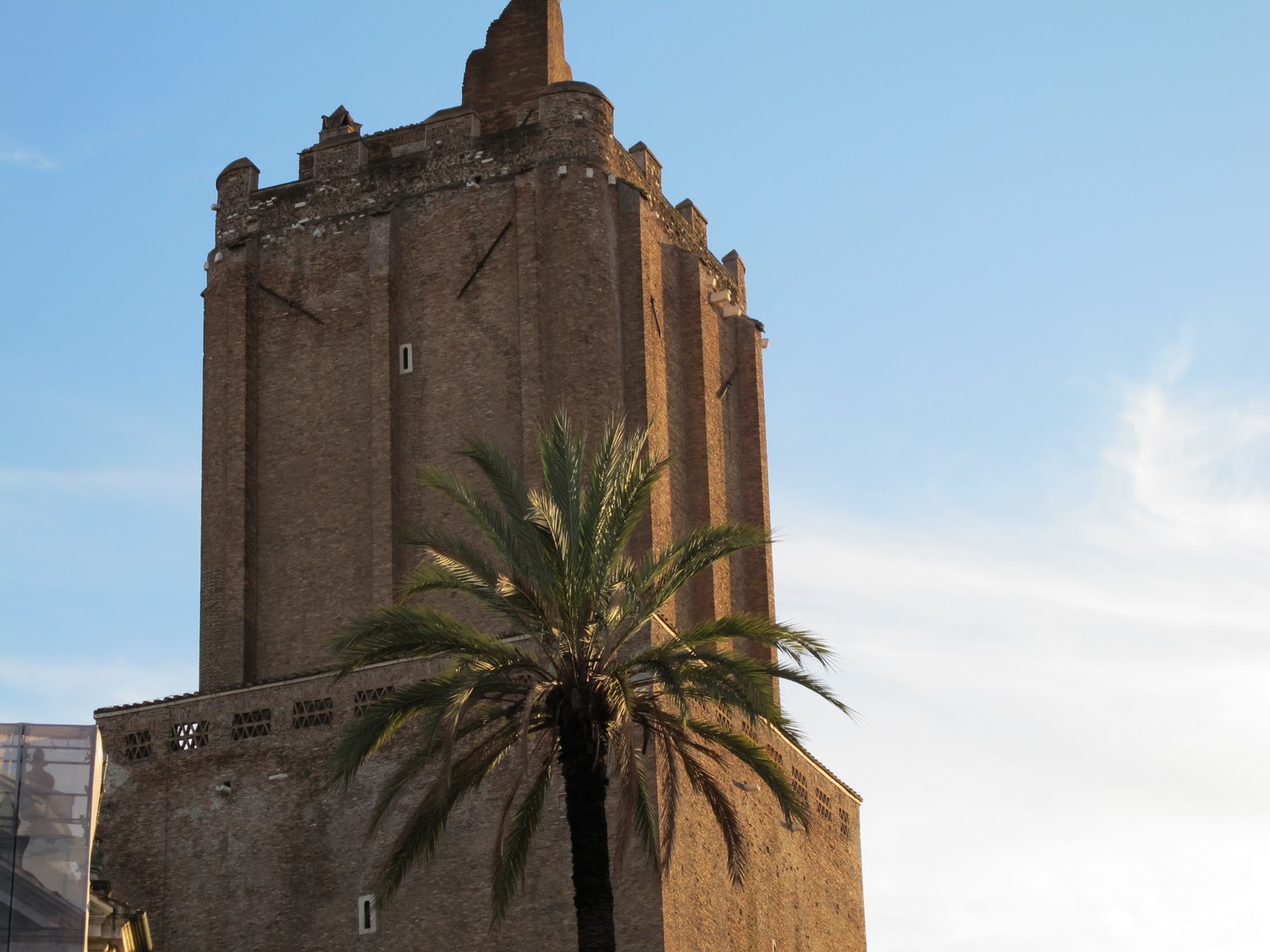
Myths about Rome - La Torre delle Milizie - Nero's "Observation Point"

On the hill right behind the Forum of Nerva, a tall tower made of red bricks stands out against the background of the sky. What looks like a quite anonymous building, is the stage for one of the biggest myths about Rome. 


The Tower, built back in 13th Century for the noble Conti family, and one of the few remaning buildings of the Middle Age in Rome, used to be a taller, three-tiered building, but the upper part was knocked down in 14th century owing to the effects of a strong earthquake that hit the City.  The name of "Torre delle Milizie" comes from an alleged presence of a military garrison's barracks, but until now, I could not find any historical evidence about this fact. 


Roman people built a myth about this tower, telling that that was the point from which the Emperor Nero watched Rome birning during the infamous fire that destroyed the city back in 64 A.D. Nothing could be farther from reality, because of 2 main facts:


- Emperor Nero was not in Rome at the outbreak of the fire, but at his seaside villa in Antium (today Anzio), and:
- the Tower was built in Middle Age, so it was not there at the moment of fire, 


but this is just one of the many stories without historical foundations who were made up in centuries of hatred against this unconventional and innovative Roman Emperor. 
Currently integrated in the archaeological complex of Trajan's Markets, the tower can be accessed entering from the same site's entrance, on Via Quattro Novembre.

Villa Medici - A Foreign Queen's Whim

Christina, Queen of Sweden, was for sure one of the most interesting people of the 17th Century. Single by choice, she secretly converted ...